
comment 0

The Disreputable History: Writing to Live up to

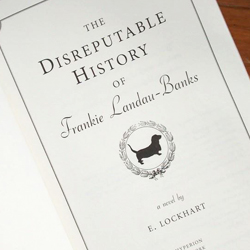
DisreputableHistory“I hate it when I read a good book. It’s so depressing.”

That’s what I moaned to my husband upon finishing E. Lockhart’s The Disreputable History of Frankie Landau-Banks. Because—seriously—how can my writing live up to that?

It’s original. It’s funny. It’s witty. It masterfully captures what it’s like to be a youth latching onto big concepts, trying to sound adult. (Whereas as an adult, the big concepts are quashed under daily tasks like chauffeuring kids to after-school activities and getting oil changes and vacuuming—it’s only young people who have time to wax philosophically.)

It’s not the traditional girl gets boy.

All of which makes me think: why can’t I write like that?

No reason, of course. I can come up with original storylines. I can be witty. I can capture what it’s like to be a teen. I can explore beyond romance. I can offer…well, moments of mirth, if not an entire book. I can do it too.

And if my strengths don’t tend toward lighthearted and upbeat, that’s okay. Dark and passionate works too. We can’t all be E. Lockharts (see also We Were Liars). Some of us need to be Gillian Flynns—or better yet, Galadriel Watsons.

What books inspire you (i.e. make you jealous)?

Read previous posts.

About the Author

Posted by Galadriel

Hi, I’m Galadriel: blogger, author, reader and resident of a quaint small town in the breathtaking West Kootenay region of southeastern British Columbia. You can also find me on Twitter and Facebook.

comment 0

The Girl on the Train

The Girl on the Train (250x250)I am now up on the times, having finished the book of the day: Paula Hawkins’ The Girl on the Train. As I was reading it, my response seemed to alter in waves:

1) The beginning: I was captured by Megan’s voice. I loved the contrast between the way Rachel had painted her in her mind, and the way Megan actually was.

2) The middle: I knew this part was supposed to be exciting and suspenseful. I knew the pages offered all the elements of excitement and suspense. I knew, from raving reviews, that other people felt excitement and suspense. And yet I wasn’t feeling these feelings in my bones. I was able to put the book down. As Rachel herself said, “It’s removed from me. It’s like it doesn’t belong to me.” Why? I’m not certain. I think maybe Rachel’s poor-me attitude and Anna’s extra-sweet goodness started to drag, plus I got confused with Megan’s unnamed he’s.

3) The end: The book picked up steam again. I started getting involved: could it have been him? could it have been her? Everyone’s a suspect and my mind started churning with possibilities.

By the time I finished the final pages, the book had become a solid thumbs-up, my middle-stretch iffyness faded. Maybe the hesitation was me: I was distracted by life’s goings-on, or had mistakenly skipped over a vital part that kept me at arms’ length. I plan to read it again to find out.

Have you read it? What did you think?

Read previous posts.

About the Author

Posted by Galadriel

Hi, I’m Galadriel: blogger, author, reader and resident of a quaint small town in the breathtaking West Kootenay region of southeastern British Columbia. You can also find me on Twitter and Facebook.

comment 0

Drawing Outside the Lines With Birdman

BirdmanI recently watched Birdman, winner of the 2015 Oscars for Best Picture, Best Directing, Best Cinematography, Best Writing.

And while I wouldn’t say it’s the best movie I’ve seen—and it certainly took full concentration to keep up with what was going on—I did get immersed in it and ended the evening with a screeching takeaway:

Create whatever moves you in the way that it moves you. Stop trying to draw inside the lines. The result may be a flop—but it may also take flight.

For Birdman is not your typical Hollywood movie. Here’s what I, as an amateur movie-watcher, noticed was different from my usual fare (please excuse my layperson’s filmmaking lingo):

  • surrealism amidst realism
  • continual camera shots
  • tight settings
  • subtle storyline arcs
  • heavy reliance on dialogue
  • little downtime.

The ensemble of people who make a movie happen took a chance and drew outside the lines. It could have been a failure, but—as the Oscars attest—it worked.

At the same time, though, I’m sure these same people knew exactly where the lines were drawn. They didn’t leap into far-flung notions—each and every one of them almost certainly had traditional training in their areas of expertise.

So the moral for my own creative endeavour (aka writing) is:

Take a chance and create as the spirit moves you to do. But first learn the rules in order to know how to break them with pizazz.

Have you seen Birdman? What did you think of it?

Read previous posts.

About the Author

Posted by Galadriel

Hi, I’m Galadriel: blogger, author, reader and resident of a quaint small town in the breathtaking West Kootenay region of southeastern British Columbia. You can also find me on Twitter and Facebook.